
The quality of care a person with cognitive decline receives does not depend only on the institution that cares for them, but on how their caregivers are trained.
That is why some decisions happen outside the rooms, yet directly affect the lives of patients and their families.
One of them has just happened.
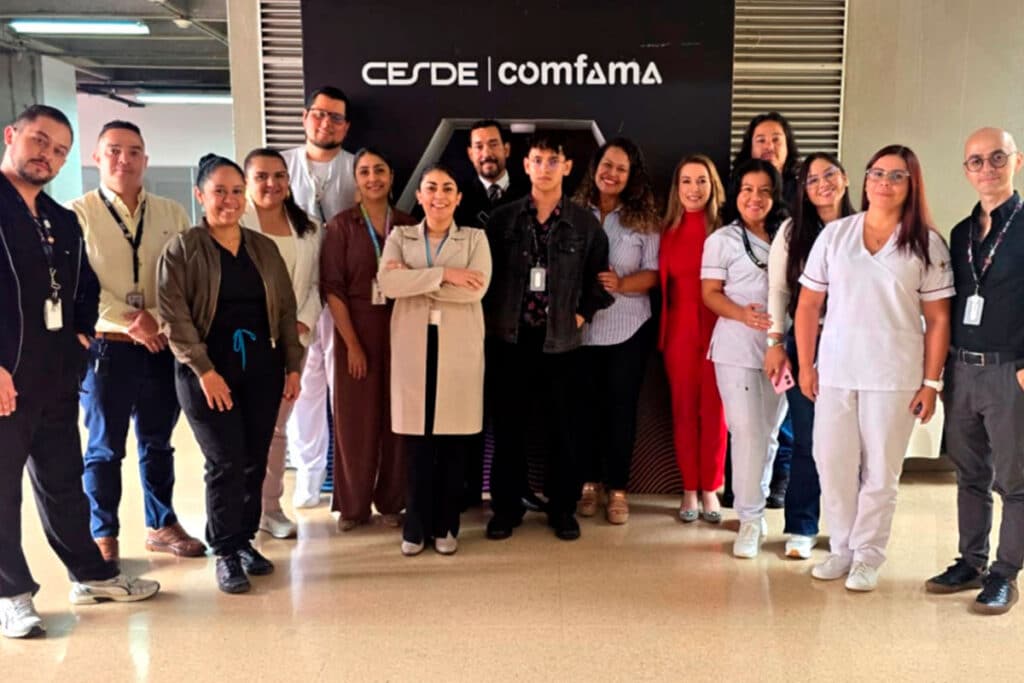
Centro Reloj de Arena was invited to join, as a founding member, the Business Advisory Council of the School of Health and Care at CESDE, a technical education institution in Colombia. It is a space where the health and care sector has a direct say in the training of future nursing assistants and care professionals.
A space that shapes how care will be provided in the future
This Council is not a one-off event or a symbolic recognition.
It is an academic governance body that brings together a small group of health sector institutions to ensure that technical training meets the real needs of the field.
Through regular sessions, this space can:
- Identify gaps in current training
- Anticipate trends in health care
- Adjust technical training curricula
- Turn day-to-day experience into concrete academic decisions
In other words, it is a direct link between what happens in the classroom and what caring for an older adult with cognitive decline really requires.
Bringing care experience into training
The participation of Centro Reloj de Arena in this Council means that its care model, based on an interdisciplinary approach, will help shape the training of new professionals.
It is not just about teaching techniques. It is about training people who can understand the complexity of care, make decisions with clinical judgment, and sustain care processes grounded in dignity, empathy and knowledge.
Spaces like this allow what is learned in practice to go beyond the institution and help raise the standard of the whole sector.
More than taking part: raising the standard of care
The invitation, extended by the rector’s office of CESDE and the management of its School of Health and Care, recognizes Centro Reloj de Arena’s track record in addressing cognitive decline and its ability to contribute to the training of skilled caregivers.
Being part of this Council means taking on an active role: not only adapting to changes in the sector, but helping to define them.
What does this mean for families?
For those who entrust us with the care of a loved one, this has a direct implication:
The institution they choose does not just apply good practices; it helps build those practices at the training level.
This translates into:
- A greater ability to attract and train qualified staff
- Constantly updated care methods
- An approach that does not stand still, but evolves with the sector
A commitment that goes beyond the institution
This partnership adds to Centro Reloj de Arena’s commitment to ongoing training, applied research and stronger networks within the health sector.
Because improving care is not just an internal task. It is a shared responsibility that begins, to a large extent, with how those who make it possible are trained.